
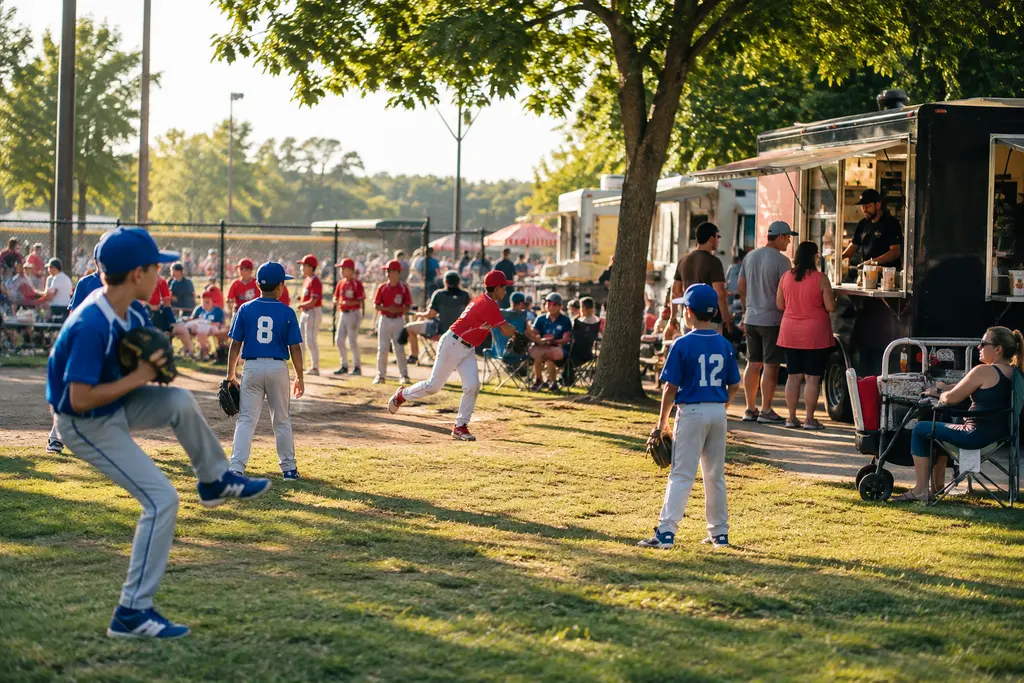

Swanger tournaments turned a stretch of baseball and softball weekends into a clear economic story for Texarkana in 2026. From February through June 2026, families crossed state lines, teams filled brackets, and local businesses felt the lift that comes when youth sports become part of a city’s weekly rhythm.
The numbers were not abstract for the people who work hotel front desks, prep restaurant kitchens, stock convenience stores, or welcome visiting families between games. Baseball has always carried a neighborhood feeling in Texas, but the Swanger Sports Complex report showed how that feeling can be measured in visitor spending, team counts, and repeat trips from beyond the local area.
According to Texarkana’s 2026 Summer Season Economic Development Report, released on August 21, 2026, tournaments at Swanger Sports Complex from February through June 2026 generated an estimated $6.5 million in direct visitor spending, with 15 tournaments drawing about 43,000 visitors and 420 teams from Texas, Arkansas, Louisiana, and Oklahoma city economic report. For a border city, that regional pull matters. It places Texarkana in the daily travel plans of baseball families who may have arrived for pool play, then left with restaurant receipts, hotel stays, and memories tied to the community.
What Swanger Tournaments Delivered In Texarkana
Swanger Tournaments By The Numbers
The clearest takeaway was the scale. Fifteen tournaments in five months meant a steady sequence of arrival days, early first pitches, concession lines, and evening meals around town. The strongest signal from Swanger tournaments was not only the $6.5 million in direct visitor spending. It was also the mix of visitors: the city report said approximately 61% came from outside the local area, which meant new spending flowed into Texarkana rather than simply moving existing local dollars from one weekend activity to another.
For Texas baseball followers, that distinction carries weight. A tournament weekend is not a single game. It is a chain of purchases tied to the sport: fuel before check-in, breakfast before warmups, ice between games, a late lunch after elimination play, and maybe another hotel night if a team reached Sunday. Youth baseball turns parents into road managers, siblings into dugout regulars, and local businesses into part of the game-day map.
Regional Reach Across Four States
The Swanger Sports Complex drew teams from Texas, Arkansas, Louisiana, and Oklahoma during the reported February through June 2026 window. That geography fits Texarkana’s identity. The city does not sit at the edge of baseball culture; it sits at a meeting point for families moving through the region for competition.
That regional reach also gave the tournaments cultural value beyond the balance sheet. A family from East Texas, a club from Arkansas, and a roster from Louisiana can share the same warmup space before playing under the same schedule pressure. Coaches compare players, parents compare travel notes, and young athletes learn what competition feels like outside their own league boundaries. In that sense, the local economy and the youth baseball pipeline were moving together.
Why The Renovation Changed Baseball Weekends
From Facility Upgrade To Visitor Growth
The city report connected the post-renovation era at Swanger Sports Complex with a major change in visitor travel patterns. Since the renovation of the complex, the report noted a 431% increase in visitors traveling 100 miles or more, along with a 68% rise in dining visits after tournament events. Those figures show that facility quality can shape how far teams are willing to travel and how much time families spend in town once the final out is recorded.
Baseball families notice field conditions, parking flow, restroom access, lighting, and the ease of moving from one game slot to the next. Those details may sound ordinary until a tournament schedule puts them under stress. When a complex can host teams with fewer friction points, it becomes easier for organizers to return, easier for coaches to recommend, and easier for parents to plan. That is where sports infrastructure becomes a community asset.
The Business Case Behind The Baseball Calendar
A 2025 impact study reported by KKYR projected 30,000 annual visitors tied to Swanger, with an expected $5.8 million in total economic output, including $3.4 million from direct visitor spending and $2.4 million from indirect and induced spending Swanger economic projection. The same report said the complex supported an estimated 49 local jobs, about $1.75 million in employee compensation, $763,000 in tax revenues, and more than $188,000 in added small-business income.
The 2026 summer report then showed how fast the venue’s tournament calendar could move beyond earlier projections during a concentrated run. That does not erase the need for careful civic planning. It does show why baseball facilities are no longer just parks department line items. They sit at the crossing of player development, family travel, hospitality work, and city budgeting.
Baseball Families And Main Street Spending

How A Tournament Day Spreads Out
A tournament day at Swanger did not stay inside the foul lines. Visitor spending spread into hotels, restaurants, retailers, and related businesses, according to the city report. That is the practical side of youth baseball tourism. A team may be listed as one entry in a bracket, but each roster can bring multiple cars, multiple meal decisions, and multiple stops across town.
Texarkana’s benefit came from repeat patterns. Families who arrived for early games needed breakfast. Teams with long breaks looked for lunch. Parents who forgot sunscreen, chairs, socks, or phone chargers made retail stops. After the last game, dining visits helped turn the sports schedule into a broader community effect. The reported 68% rise in dining visits after tournament events put a number behind a scene many local restaurant workers likely recognized by uniform tops and dusty cleats.
Why The Culture Matters As Much As The Count
The cultural side of the story deserves space beside the spending totals. Texas baseball is built on rituals: grandparents in folding chairs, players carrying bat bags bigger than their shoulders, coaches gathering teams in the shade, and families making a town their temporary home for a weekend. Swanger Sports Complex gave those rituals a regional stage in 2026.
That is why the economic story should not be separated from the baseball story. Local businesses did not simply serve anonymous visitors. They served teams chasing bracket wins, parents balancing budgets, and young athletes learning how travel ball stretches discipline beyond practice nights. For more on how earlier tournament weekends shaped Texarkana’s sports economy, our coverage of Texarkana baseball spending tracks a related local thread.
The best sports towns understand that tournament visitors may become repeat visitors if the experience feels organized, friendly, and worth the drive. Texarkana’s 2026 numbers suggested Swanger had already become part of that decision-making process for many families.
What Swanger Tournaments Mean For Texarkana Baseball
Swanger tournaments gave Texarkana a sports-first economic case study in 2026. The city had a venue that drew teams across four states, a tournament schedule that brought measurable visitor spending, and a baseball culture that reached into hotels, restaurants, and small businesses.
The lesson is not that every youth sports project will produce the same return. The supported record here is specific: from February through June 2026, Swanger Sports Complex hosted 15 tournaments, welcomed about 43,000 visitors, drew 420 teams, and generated an estimated $6.5 million in direct visitor spending. Those are the facts that matter for local leaders, business owners, coaches, and families weighing how baseball fits into Texarkana’s civic identity.
For the players, the value still began between the lines. They came to compete, adjust, fail, respond, and learn under tournament pressure. For the city, those same games created a wider return. That is the enduring appeal of Texas baseball at the local level: a weekend schedule can carry the sound of bats, the habits of families, and the economic pulse of a community all at once.