
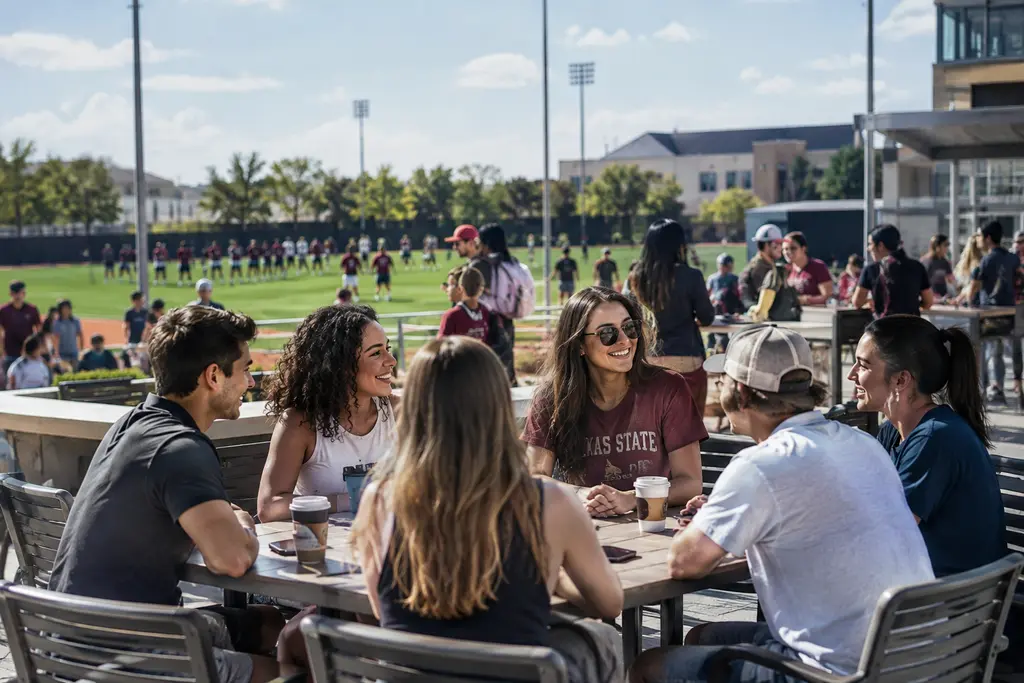

The Texas State Facility Overhaul is more than a campus building plan. For San Marcos, it is a sports story, a local business story, and a cultural marker for a university town where Bobcat athletics shape weekends, family routines, and civic pride. The numbers behind Texas State University’s growth are large, but the local meaning is found in smaller scenes: restaurant tables before first pitch, students walking from residence halls toward athletic venues, and alumni returning to a campus that keeps changing around them.
Texas State reported $7.7 billion in statewide economic impact in FY 2023-24, supporting 75,078 jobs in Texas, according to the TXST economic impact report. That figure is not a baseball statistic, and the available research does not assign a baseball-only dollar amount to the facility work. Still, for readers who care about Texas baseball, the university-wide impact matters because college sports depend on the same campus systems that serve students, workers, visiting families, and game-day crowds.
The Texas State Facility Overhaul and Local Sports
Texas State Facility Overhaul as a Game-Day Signal
The Texas State Facility Overhaul tells San Marcos that Texas State is preparing for a larger student body, a wider alumni base, and more pressure on campus space. The approved 2025-2035 master plan, approved on May 1, 2025, anticipated growth to more than 50,000 students by Fall 2033. The plan included 30 new facilities and renovations of more than 20 green spaces and academic buildings. Those details matter to sports fans because game days do not happen in isolation. They rely on parking patterns, pedestrian routes, dining capacity, campus safety, and the feel of the public spaces around venues.
For baseball, the connection is practical and cultural. A stronger campus core can help make a midweek game or weekend series part of a larger San Marcos visit. Families may build a day around campus walks, local meals, and a ballgame. Students may decide whether a game is easy to reach between classes, work, and residence life. Alumni may judge the health of the school not only by wins and losses, but by whether the campus feels cared for when they return.
Why Sports Infrastructure Shapes Belonging
Texas baseball has always been tied to place. In San Marcos, that place includes the university, the river city around it, and the businesses that serve both students and visiting fans. When Texas State invests in facilities, the benefits can extend into the rituals that make college sports feel local: pregame meals, youth players wearing Bobcat colors, parents comparing campus changes since their own college years, and small businesses staffing up for heavier traffic days.
That is why the sports side of this story should not be limited to a single venue. The completed UFCU Stadium End Zone Complex Expansion, a $42 million project that began on October 3, 2023, and reached substantial completion on July 25, 2025, is tied to football, but it still reflects a broader athletic department and campus growth pattern. Baseball supporters can read that project as part of a wider shift in how Texas State presents itself in college athletics. For readers tracking the diamond more directly, our prior coverage of Texas State baseball facilities explains how facility investment can feed player development and local game-day culture.
Construction Spending and the San Marcos Sports Economy
Short-Term Work With Long-Term Visibility
Construction is one of the clearest ways a campus plan enters the local economy. Texas State reported that construction spending in FY 2023-24 added $95 million in income to the Texas economy as a short-term boost, according to TXST impact data. That spending includes wages, vendor demand, and related activity that can be felt beyond the edge of campus.
For San Marcos, the visible parts of construction carry meaning. Cranes, fencing, detours, and crews can test patience, but they also signal work moving through the community. Local sports fans often see that change first because they travel the same corridors again and again for games. A parent driving in for a baseball series notices different traffic flows. A former student sees a new building where an old shortcut used to be. A local restaurant owner reads construction schedules as part of staffing and ordering decisions.
Where Baseball Fits in the Business Rhythm
Baseball’s economic value is often steady rather than loud. A home schedule can bring repeat traffic across multiple months, with families, students, scouts, alumni, and youth teams all moving through town in different patterns. The Texas State Facility Overhaul can affect that rhythm by changing where people park, how long they stay near campus, and whether they see San Marcos as a full day trip rather than a quick stop.
The research available for this report supports broad economic impact, not a direct estimate for baseball spending. That distinction matters. It would be easy to overstate the effect of a single sport, but the better reading is that baseball sits inside a larger ecosystem. University growth can lift hotel demand during packed weekends, dining traffic before and after games, and retail sales tied to campus visits. The exact share connected to baseball remains uncertain from the provided data, but the sport clearly shares in the same local infrastructure that supports student life and campus events.
Campus Growth, Fan Culture, and Baseball

Students as the Base of the Crowd
A larger student body changes the potential audience for every campus sport. Texas State projected enrollment nearing 48,000 students in Fall 2026 after growth of more than 6,000 students since Fall 2022. That kind of increase can shape who finds a team early, who brings friends to a first game, and who carries a sports habit after graduation. Baseball benefits when students see the ballpark as part of campus life rather than an extra trip.
The Juniper and Verbena residence halls, a $280 million investment that broke ground in October 2025, were planned to add more than 1,500 student beds and a new dining hall, with estimated completion in August 2027. Housing and dining may sound separate from sports, yet they influence attendance patterns. Students who live closer to campus activity are more likely to make short-notice plans. Dining capacity can also shape pregame movement, especially for evening games after class.
Place-Making Beyond the Scoreboard
The master plan’s stated themes included Student Success & Experience, Academic Excellence, Discovery & Research, Community & Connectivity, and Stewardship of Resources. Renovation targets included academic buildings such as Chemistry Hall, Evans Liberal Arts, Supple Science, and Taylor-Murphy. Those are not baseball facilities, but they affect how the campus feels to the people who pass through it on sports weekends.
That matters in Texas baseball culture because the game is often intergenerational. Grandparents, parents, and children may share the same bleachers, but they also share the walk from the car, the meal before the game, and the memory of how campus looked on a given Saturday. Facility work can strengthen those memory points if it improves access, comfort, and public gathering spaces. It can weaken them if planning ignores how fans and students move on game days. The best reading of the Texas State plan is that athletics, academics, housing, and public space are becoming more connected parts of one campus story.
Why Texas State Facility Overhaul Matters in San Marcos
A Local Sports Story With Measurable Stakes
The Texas State Facility Overhaul matters because it links sports identity to the everyday economy of San Marcos. It is not only about buildings. It is about how a university town handles growth, how fans experience campus, and how local businesses respond to the steady pull of students, alumni, and visiting families. Baseball gives that story a human scale: a series weekend, a parent’s visit, a youth player watching college athletes up close, and a local server working a busy postgame rush.
As of October 24, 2026, several parts of the overhaul had already moved from planning into construction or completion, while other pieces were still aimed at later dates such as August 2027 and Fall 2033. The supported data shows a university with major statewide impact and a construction program already adding income to Texas. The cultural effect will be measured more slowly, through how often people choose to stay, gather, return, and make Texas State sports part of their San Marcos routine.