
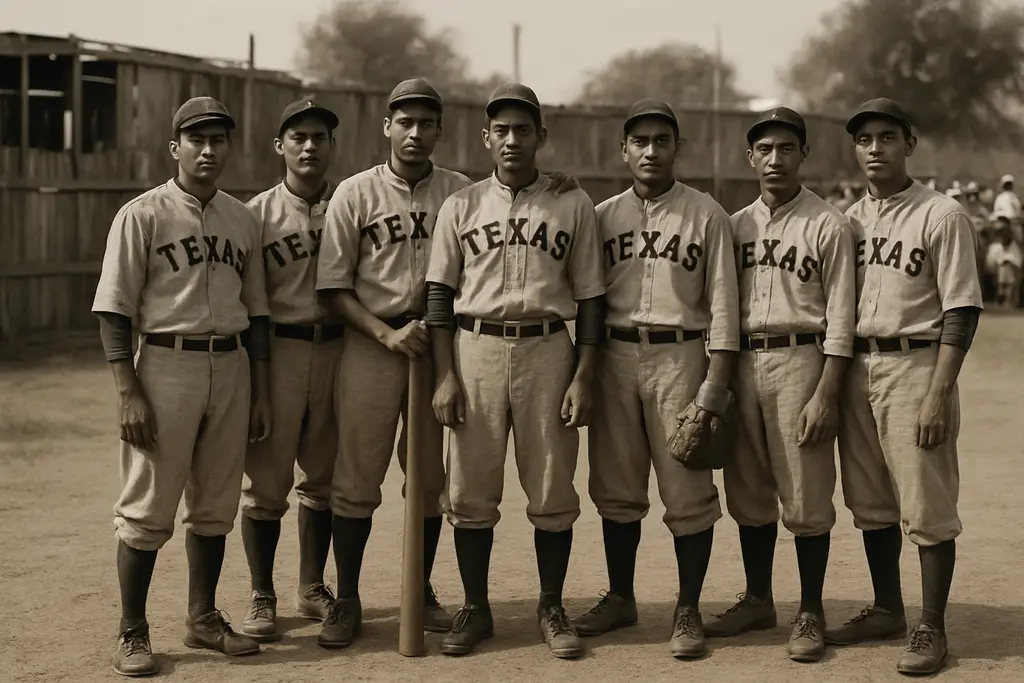

South Asian baseball in Texas is a story shaped as much by absence as by arrival. The available record for the mid-19th to mid-20th century does not show documented South Asian teams, leagues, or players tied to the origins of Texas baseball. That matters because Texas baseball grew through neighborhood clubs, segregated competition, workplace teams, school fields, and town pride. If a community was present in that sports culture, historians often find it through box scores, photographs, team rosters, newspaper notes, or local memory. For South Asian communities, the early trail is not yet visible in the verified record.
That absence should not be treated as a closed door. It should be read carefully. Texas has long been home to Asian American stories, and the Texas Historical Commission has documented Asian American presence in the state reaching back nearly 200 years in Medallion Fall 2021. Yet the same kind of public historical material reviewed for early Texas baseball does not identify South Asian baseball clubs or players from 1900 through 1950. The result is a quieter, more exact story: early influence is not supported, while modern representation is supported.
The Record On South Asian Baseball In Texas
Why South Asian Baseball Is Hard To Trace Early
Early Texas baseball developed through communities that were already large enough, organized enough, and visible enough in local press to form clubs. Research on the state’s early game points to Anglo, Black, and Hispanic teams as the main documented lines of play. By the 1890s, baseball had spread widely across Texas communities, and many towns had teams connected to race, language, labor, school ties, or civic groups. Those records show Black teams, Hispanic teams, and White teams playing within the social limits of their time.
For South Asian communities, the same kind of record has not surfaced for the foundational period. No verified team names, league schedules, rosters, or early newspaper accounts in the research identify Indian, Pakistani, Bangladeshi, Sri Lankan, or other South Asian players as part of Texas baseball’s first generations. That does not prove no individual ever picked up a bat in a local game. It does mean that no credible public record now supports a claim of organized South Asian influence on early Texas baseball.
What The Silence In The Archive Tells Fans
Sports history often leans on what communities left behind: team photos, scorebooks, church picnic reports, school yearbooks, and local newspaper summaries. When those materials are missing, the responsible move is to avoid filling the gap with guesswork. In this case, the silence points toward demographic timing and community scale. South Asian immigration to Texas became more visible later, especially after federal immigration changes in the second half of the 20th century. Before that period, South Asian populations in Texas were small, making large organized baseball ventures less likely to appear in city leagues or regional baseball pages.
This is where careful Texas baseball writing serves the community. Fans deserve a record that respects documented Black baseball, Tejano baseball, Anglo town ball, and newer immigrant stories without blending them into one unsupported claim. The absence of early South Asian baseball evidence is not a slight. It is a prompt to keep looking in family collections, school archives, and local parks records while being honest about what has been verified.
Where Texas Baseball Records Are Stronger
Documented Community Baseball Traditions
Texas has stronger documentation for other community baseball traditions from the same early periods. Research notes point to Tejano baseball, Mexican-American teams in South Texas and the Houston area, and Black baseball traditions connected to segregated play. Those stories are not side notes. They shaped how neighborhoods gathered, how players found competition, and how baseball became part of civic identity across the state.
That contrast helps explain why the South Asian record stands out. In Texas baseball history, some communities left a visible sports paper trail because they had teams, leagues, rivalries, and public events. Other communities were present in Texas life but not yet recorded in baseball spaces. For readers who follow the state’s broader baseball memory, the distinction also connects with local efforts to honor Black baseball history, including this site’s feature on Texas Negro League Tribute Night. The comparison is useful because it shows how public recognition usually follows preserved names, games, and places.
Why Verified Gaps Still Have Value
A verified gap can be valuable when it keeps the story clear. It tells museum workers, school historians, youth coaches, and families where research is still needed. It also prevents modern communities from being placed into early timelines without evidence. In a state with many baseball origin stories, that discipline matters. It protects the credibility of local sports history and leaves room for future oral histories if families or community groups uncover records that have not reached public archives.
For South Asian baseball, the better question may be less about whether an early organized influence can be claimed today and more about how the sport became a bridge later. Children of immigrant families often meet American sports through school teams, parks departments, college programs, and neighborhood friendships. Baseball can sit alongside cricket, soccer, and other sports that families brought with them or kept close through community clubs. That mix belongs to the modern Texas story, even if it does not rewrite the origins period.
Karan Patel And A Modern Texas Breakthrough
UTSA, The White Sox, And A Verified Milestone
The clearest verified high-level connection between South Asian heritage and Texas baseball is Karan Patel. On June 4, 2019, the Chicago White Sox selected Patel, a pitcher from the University of Texas at San Antonio, in the seventh round with the 200th overall pick in the MLB Draft, as reported by MLB.com on Patel. That moment gave Texas baseball fans a concrete reference point: a South Asian American athlete developed through a Texas college program and entered professional baseball through the draft.
Patel’s story also carries a useful cultural detail. He played cricket as well as baseball, and his background included the U-19 USA Cricket Team during high school, according to the research provided. That dual-sport path makes sense to many South Asian families in Texas. Cricket remains familiar in many households, while baseball is built into school athletics, college recruiting, and summer development. Patel’s path did not erase one sport to validate the other. It showed how an athlete could carry both influences into his pitching identity.
Why One Player Matters Without Overstating The Past
One player cannot stand in for every South Asian family in Texas, and one draft selection does not create an early history where records do not exist. Still, Patel’s selection matters because it is verifiable, Texas-based, and tied to player development. It gives younger athletes a name they can point to when explaining that South Asian identity and baseball are not separate worlds.
For local coaches and college recruiters, that matters in practical terms. Texas baseball draws talent from suburbs, border towns, rural schools, city select programs, and college campuses. As South Asian communities grow in places such as Dallas-Fort Worth, Houston, Austin, and San Antonio, the youth pipeline can include more players who grew up with both cricket bats and baseball gloves. The historical record does not yet show early organized influence, but the modern player pool can still widen through school access, family support, and coaches willing to understand different athletic backgrounds.
Community Identity Beyond The Early Record

How Families Build New Baseball Memory
Community identity in baseball is not created only by old leagues. It is also made when parents learn scorekeeping, when grandparents attend a first Little League game, when local restaurants sponsor youth jerseys, and when college programs recruit athletes from households with several sports traditions. For South Asian families in Texas, baseball memory may be younger than that of other communities, but younger does not mean less meaningful.
The key is to keep the timeline honest. South Asian baseball should not be presented as a force in Texas baseball’s 19th-century origins without records. It can be presented as an emerging part of the state’s modern baseball culture, especially when tied to verified examples like Patel and to the broader growth of Asian American visibility in Texas life. That framing lets the community claim what is real without borrowing from another group’s documented past.
Local Research That Could Change The Picture
Future discoveries may come from small places rather than major archives. A family photo from a company picnic, a school roster from the 1970s, a local parks registration sheet, or an oral history from a first-generation college student could add detail to the record. Those materials would need names, dates, locations, and context before they could support a stronger claim. Until then, the most accurate reading is that early influence has not been documented.
That kind of research would fit Texas baseball well. The state’s game has always been local before it becomes famous. Town teams, school diamonds, amateur tournaments, and neighborhood rivalries often carry stories for decades before anyone writes them down. If South Asian families have baseball memories from the late 20th century that are not yet archived, preserving them now would help future fans understand how the sport reached new households.
What South Asian Baseball Means For Texas Memory
The honest story of South Asian baseball in Texas is not an origin claim. It is a record of limited early evidence and clearer modern arrival. That distinction gives the topic its value. It shows how Texas baseball history can welcome new communities without reshaping the past beyond what sources support.
For fans, the lesson is simple: absence in the archive should be handled with care, not ignored and not inflated. Early Texas baseball belongs to the communities whose teams and players are documented in the record. Modern Texas baseball has room for new stories, including South Asian athletes whose paths may run through cricket, public schools, college programs, and professional drafts.
Patel’s 2019 draft moment gives the state a verified marker. The next part of the story may be built at youth fields, college bullpens, and family gatherings across Texas. If those stories are saved with dates, names, and places, future historians will not have to guess. They will have the record that early South Asian baseball in Texas does not yet provide.