
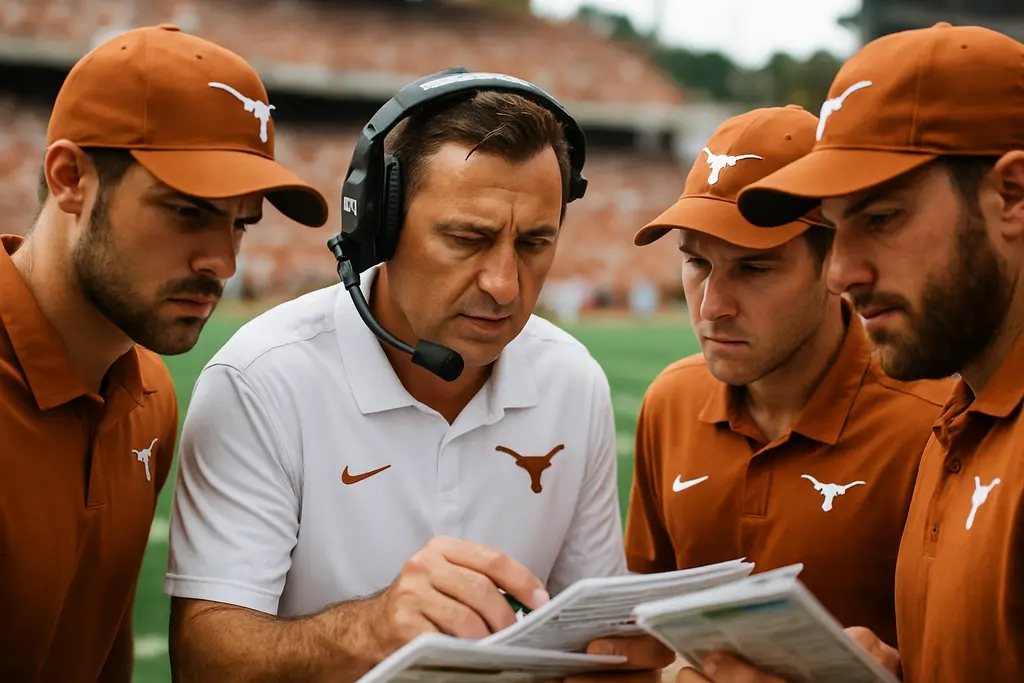

Texas Coaching Staff changes at the University of Texas did more than reshuffle names on a football directory. They gave Austin another chapter in the way historic programs are judged, remembered, and discussed across sports bars, family tailgates, radio segments, and youth fields. For readers who live around Texas baseball, the pattern feels familiar: roster talent matters, but the staff around athletes often shapes development, identity, and the story fans tell about what comes next.
By September 4, 2026, the main moves had already happened. The program made defensive changes in December 2025, added offensive and secondary staff help by January 2026, and had contract details move through university governance in February 2026. The result was a staff reset that said plenty about how Texas viewed competition, continuity, and the cost of staying near the front of college football.
Texas Coaching Staff Changes At A Glance
Defensive Reset After December 2025
On December 18, 2025, head coach Steve Sarkisian announced that Will Muschamp would return to Texas as defensive coordinator. That move followed the decision not to retain Pete Kwiatkowski, who had spent five seasons in the defensive coordinator role, and Duane Akina, who had served as defensive passing game coordinator. The timing mattered because it came before the deepest offseason staff-building period, giving the program a chance to define responsibilities before player development work moved into the next cycle.
Muschamp’s agreement covered December 19, 2025, through February 28, 2029. His annual salary was set at $2.7 million in 2026, $2.8 million in 2027, and $2.9 million in 2028, according to the research notes. That level of investment made the defensive coordinator job one of the most visible staff decisions in Austin sports conversation during the first half of 2026.
Texas Coaching Staff And Local Expectations
The Texas Coaching Staff reset did not stop with the coordinator chair. On December 12, 2025, Texas hired Jabbar Juluke as associate head coach for offense and running backs coach, replacing Chad Scott. Juluke came from Florida, where he had worked as associate head coach and running backs coach. On January 16, 2026, Blake Gideon returned to Texas as defensive passing game coordinator and secondary coach after serving as defensive coordinator at Georgia Tech in 2025. He had previously worked at Texas from 2021 through 2024 as safeties coach.
The salary structure showed different kinds of commitments. Juluke was set to earn $325,000 for 2026, with a contract rise to $850,000 for the 2027 season, according to the research notes. Gideon was set to earn $800,000 in 2026, a figure lower than both his reported 2025 Georgia Tech defensive coordinator salary and what Akina earned for the same Texas position in 2025. Those numbers gave local followers a window into how the program balanced title, fit, recruiting value, and budget.
How The Staff Shift Reached The Austin Sports Community
Contracts, Spending, And Public Accountability
College coaching contracts at a public university are not just internal athletics documents. They become part of public record, which gives supporters, alumni, taxpayers, and local media a chance to read how a program chooses to invest. During the February 18-19, 2026 meeting cycle, the University of Texas System Board of Regents consent agenda included an amendment for offensive coordinator and offensive line coach Kyle Flood, setting his annual salary at $1.525 million for the 2026-2027 offseason, with no salary bump for that period but with an added contract year, according to the UT System agenda.
Co-defensive coordinator and linebackers coach Johnny Nansen also received an extension through 2027, with an annual salary of $1.2 million in both 2026 and 2027, according to the research notes. In the same staff cycle, several analyst and support roles changed. Mike Bimonte was elevated to co-passing game coordinator and assistant quarterbacks coach from senior analyst. Jason McEndoo moved from tight ends analyst to senior offensive line analyst. Matt King joined as assistant strength coach after time at Michigan State. Steve Casula, Billy Gonzales, J.B. Brown, and Jackson Ponder were added in analyst roles across position groups.
That is why the Texas Coaching Staff story carried weight across Austin. It was about more than one sideline headset. It touched strength work, position teaching, film support, recruiting presentation, and the daily structure that athletes experience before game day ever arrives.
Why Spending Becomes A Local Story
The Longhorns were set to spend at least $11.55 million on assistant coaches in 2026, up from the prior year, according to state documents cited in a Yahoo Sports report. That figure gave local media a clear frame: Texas was paying for staff depth at a level that matched the pressure around the program.
For Austin businesses around campus, staff investment does not guarantee wins, and it should not be treated as a scoreboard by itself. Still, the choices feed the sports calendar. Offseason talk drives call-in shows, newsletters, alumni gatherings, and the everyday conversations that happen in coffee shops and restaurants near campus. In that sense, coaching hires become part of the local sports economy’s rhythm even before a season begins.
Media Storytelling Around Historic Team Building

Names Become Narrative
Historic teams are often remembered through players first, but staffs become part of the memory once time passes. Baseball followers know this well. A manager, pitching coach, hitting coach, or player development director can become shorthand for an era. Football works the same way in public conversation. A coordinator hire signals style. A returning assistant signals trust. A contract extension signals patience or urgency, depending on the moment.
That is where the Texas Coaching Staff coverage gained traction. Muschamp’s return gave reporters an easy storyline because he had prior Texas ties and a long public profile. Gideon’s return carried a different kind of local resonance because he had worked in Austin earlier in the decade. Juluke’s hiring added an offensive development angle. Flood’s amended contract and Nansen’s extension gave the story a budget and continuity layer.
For a Texas baseball audience, this kind of coverage mirrors how championship memories are built around more than final scores. Development systems, staff chemistry, and local belief all shape how supporters remember a season. Readers who follow Texas Baseball Champions historic seasons have seen how one strong year can become part of community language long after the last out.
The Grassroots Connection
The staff story also filters down to younger athletes. A university program’s choices can influence how high school coaches, private instructors, and parents talk about preparation. No single hire creates a youth movement by itself. Still, when a major Texas program places clear value on position coaching, analyst work, strength training, and staff continuity, that message reaches the wider coaching community.
In baseball terms, that message is easy to understand. Player development rarely belongs to one person. It depends on repeated instruction, trust, teaching language, and the ability to connect athletes with a plan. The Longhorn football moves offered another local example of a major program treating staff structure as part of competitive planning, not background paperwork.
Why Texas Coaching Staff Changes Matter In Austin
The Texas Coaching Staff updates mattered because they tied together money, identity, and memory. Austin does not receive these decisions as a private workplace shuffle. The city reads them through program expectations, campus pride, and the long-running debate over how much support a major college team needs to compete.
There is also a cultural point that reaches across Texas sports, including baseball. Communities remember eras through the people who built them. Sometimes that is a star player. Sometimes it is a coach who recruits, teaches, and steadies the room. Sometimes it is an analyst or support staff member whose work is less public but still shapes preparation. The 2025-2026 Texas staff cycle gave local fans a clear reminder that historic programs are not only built on game day. They are built through the decisions made months earlier, in contracts, offices, weight rooms, practice fields, and the stories a community chooses to keep telling.