
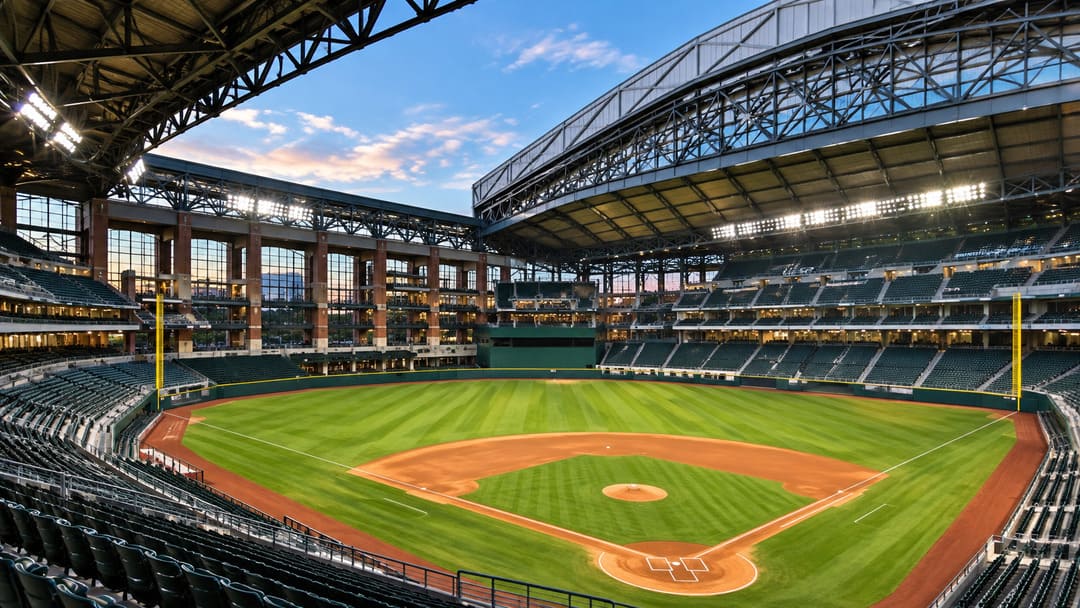

A 95-degree afternoon in Arlington does not necessarily mean baseballs will fly farther when the Texas Rangers take the field. Globe Life Field’s retractable roof can separate the playing environment from the weather outside, complicating one of the most familiar assumptions in MLB totals betting: hotter weather means more runs.
For readers researching how to bet on baseball in Texas, the legal distinction comes first. Texas does not currently operate a state-licensed sportsbook market, and internationally operated betting platforms do not carry Texas licenses. Understanding that landscape is separate from evaluating the baseball itself, where weather, pitching matchups and ballpark conditions all influence how a game might unfold.
The Rangers’ home stadium offers a particularly interesting case. Although the retractable roof dominates discussions of the building, Globe Life Field has also developed a measurable reputation for suppressing scoring. The challenge is understanding whether that historical pattern says anything useful about a particular game’s betting total.
Globe Life Field Has Become One of Baseball’s Tougher Scoring Environments
When Globe Life Field opened in 2020, its retractable roof represented a major change from the franchise’s previous outdoor stadium. The architectural transformation fits into the broader history of Texas ballpark design, where controlling the playing environment has become an increasingly important part of modern stadium construction.
But the more interesting development for bettors has been the stadium’s measurable effect on offense.
MLB’s Statcast park factors provide a useful starting point. Across the 2024–2026 period, Globe Life Field recorded a run-scoring index of 88, compared with the league-average benchmark of 100.
That means the park was associated with roughly 12% less run scoring than the average environment under Statcast’s adjusted comparison. It does not mean every Rangers home game should be projected to produce 12% fewer runs.
The distinction is crucial because park factors describe observed conditions over many games. They do not account for every detail of the next matchup.
| Statcast metric, 2024–2026 | Globe Life Field index | What it tells bettors |
|---|---|---|
| Run scoring | 88 | Scoring was below the league-average environment |
| Home runs | 93 | Home-run production was moderately suppressed |
| Hard-hit rate | 100 | Hard contact occurred at approximately the league-average rate |
| Strikeouts | 101 | Strikeout frequency was close to the MLB average |
The contrast between run scoring and hard-hit rate is particularly revealing.
Globe Life Field did not simply prevent hitters from making hard contact. Its 100 hard-hit index suggests contact quality, measured by that statistic, remained close to average even while overall scoring was lower.
A bettor who sees a pitcher-friendly park and automatically assumes hitters cannot generate dangerous contact would be missing that distinction.
Lower scoring does not necessarily mean weaker contact. How batted balls turn into hits, extra bases and runs also matters.
Why the Retractable Roof Changes the Weather Calculation
Globe Life Field’s roof is not a minor architectural feature.
The Rangers official stadium specifications describe a 5.5-acre retractable structure capable of opening in approximately 12 minutes. Its climate-control system was designed to maintain comfortable conditions during the intense North Texas summer.
For baseball analysis, the roof creates two materially different environments.
When closed, the stadium largely shields play from the direct influence of outdoor wind and temperature. A forecast showing strong winds across Arlington becomes considerably less relevant to ball flight inside the enclosed park.
When open, outside conditions can influence the playing environment more directly. Wind direction, air density and temperature may become relevant again.
That does not establish that open-roof games are automatically higher scoring.
Roof decisions are not random. The building is more likely to be enclosed during uncomfortable or threatening weather, meaning open-roof and closed-roof games may occur under different seasonal conditions.
Comparing their average run totals without accounting for opponents, pitchers, lineups and other variables can therefore produce a misleading result.
A hotter outdoor temperature is not enough to justify an over. A closed roof is not enough to justify an under.
The roof changes which weather information matters, not the direction every game must go.
Three Betting Mistakes That Globe Life Field Exposes
Treating a park factor as a ready-made betting projection
Suppose a hypothetical matchup has a neutral-park projection of 8.6 runs.
It might seem reasonable to multiply that number by Globe Life Field’s 0.88 run index and arrive at approximately 7.6 runs.
That calculation is mathematically straightforward but analytically unreliable.
Statcast’s park factor is an adjusted historical measure, not a universal multiplier designed to price an individual game. A proper projection must incorporate the teams, starting pitchers, bullpen availability, likely lineups and the way the stadium affects different offensive outcomes.
Applying an additional park adjustment to a projection that already accounts for the venue would also double-count the same information.
Assuming the betting market has ignored the stadium
Globe Life Field’s scoring characteristics are public information. Professional oddsmakers and sophisticated bettors can account for the venue when evaluating game totals.
The relevant question is not whether Arlington generally suppresses scoring.
It is whether the available total already reflects that tendency accurately.
A stadium that regularly produces fewer runs may justify a lower baseline total without creating any automatic advantage for under bettors.
Using weather before checking the roof
An outdoor forecast can be useful, but only if the weather is likely to affect play.
A bettor who models a strong southerly wind without confirming whether Globe Life Field will be open risks building an entire projection around conditions that may not apply.
Before interpreting wind direction or temperature, the roof’s expected status should be established from reliable game-day information.
Unconfirmed roof status is an uncertainty to acknowledge, not a reason to assume the outcome most favorable to a preferred bet.
Pitching Still Matters More Than the Stadium Label
Consider two hypothetical Rangers games scheduled at Globe Life Field.
In the first, both clubs have rested bullpens, dependable starting pitchers and healthy defensive alignments. A lower-scoring projection may be reasonable even without a particularly strong park adjustment.
In the second, both starters are expected to pitch only four innings, several high-leverage relievers worked the previous night, and both offenses are fielding their strongest available lineups.
The stadium remains exactly the same. The expected scoring environment may not.
This illustrates why bullpen workload can be more consequential than the roof itself when projecting certain matchups.
A starter with excellent season-long numbers may not offer the same value after multiple difficult outings or a recent injury. Likewise, a bullpen’s full-season ERA can hide a short-term shortage of its most reliable relievers.
Lineup construction introduces another variable. Missing a powerful hitter changes a team’s offensive potential, while a favorable platoon matchup can make an otherwise ordinary lineup more dangerous.
Park factors are most useful when they provide context for those baseball-specific questions rather than replace them.
How to Evaluate an MLB Total Without Inventing an Edge
A practical totals evaluation should proceed in a logical order.
First, establish the confirmed starting pitchers and projected lineups. Examine the pitchers’ current form, expected workloads and relevant performance indicators rather than relying solely on win-loss records.
Next, assess bullpen availability. A closer who pitched on consecutive nights or a setup reliever unavailable after a heavy workload can materially alter the later innings.
Then consider the park. Globe Life Field’s history of below-average scoring should influence the baseline, but the adjustment should reflect the specific matchup and avoid double-counting factors already present in the model.
Weather and roof conditions come next. An open roof makes atmospheric information more relevant; a closed roof reduces the value of outdoor wind assumptions.
Finally, compare the resulting projection with the actual betting price.
For illustration, a hypothetical total of 8.5 runs settles under at eight or fewer runs and over at nine or more. Even a projection averaging 8.2 runs does not automatically establish a profitable under wager. Bettors need a probability distribution, not just an average.
At hypothetical odds of -110, a wager needs to win approximately 52.4% of the time to break even before considering other costs.
Without a defensible probability estimate above that threshold, the apparent difference between a personal projection and the posted total is not sufficient evidence of value.
The appropriate conclusion may simply be that the available information does not support a wager.
What Globe Life Field Teaches Us About Future Rangers Games
The Rangers’ stadium provides a useful example of how modern baseball analysis has moved beyond generic descriptions of hitter-friendly and pitcher-friendly parks.
Globe Life Field combines controlled indoor conditions, unusual architecture and a history of relatively low run scoring. Those characteristics matter, but none determines a game’s outcome independently.
The 2024–2026 Statcast figures establish a meaningful historical baseline. They do not guarantee the same scoring pattern in 2027 or in any individual matchup.
For future Rangers home games, the strongest evaluation will connect the venue with current pitching, offensive health, bullpen availability and actual market prices.
A ballpark can influence scoring without creating a reliable betting advantage.
That is the essential lesson from Globe Life Field. Understanding the roof and the numbers behind it makes for better baseball analysis. Assuming those factors automatically predict an under does not.