
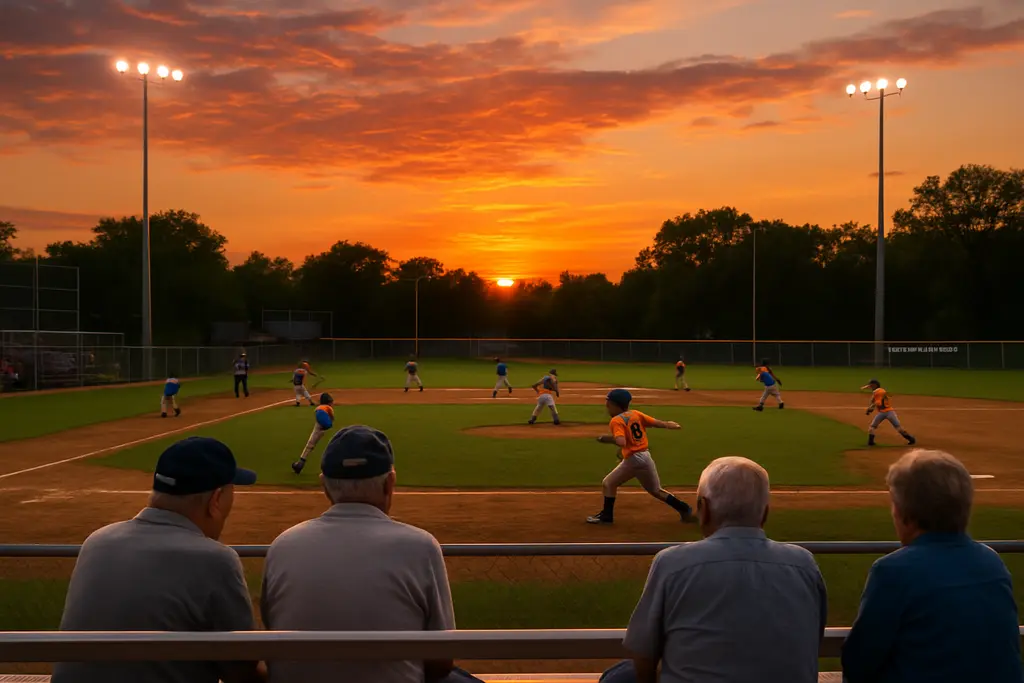

The Ingram ballfields returned as more than a youth sports venue after the July 4, 2025 Hill Country floods. For families in Ingram, the Little League Ballpark had carried years of first practices, nervous at-bats, team photos, and spring routines. When floodwater tore through the site, the loss reached beyond fencing and infield dirt. It interrupted a local baseball habit that had helped mark childhood, family weekends, and neighborhood identity.
Because this story sits at the crossing of sports infrastructure and heritage preservation, the rebuilt park matters in a specific Texas way. Small-town baseball fields are not museums, yet they preserve memory through use. A dugout keeps its meaning because players sit in it. A backstop matters because grandparents stand behind it. A practice cage becomes part of a youth pipeline because coaches return there with the next group of kids. In Ingram, rebuilding meant protecting that living sports memory while giving young players a safer, stronger place to play.
How Ingram ballfields Came Back After The Flood
What Ingram ballfields Lost On July 4, 2025
The damage described after the flood was severe. KSAT reported that the Ingram Little League Ballpark’s primary and practice fields were completely destroyed, along with 7,000 to 8,000 feet of fencing KSAT report. Those details matter because they show why a simple cleanup could not bring the park back. A youth baseball facility depends on connected pieces: fencing for game boundaries and safety, playable dirt and grass, batting areas, dugouts, and places for families to gather. When those pieces disappeared together, the town faced a full sports rebuild.
The loss also changed the rhythm of the community. In a small baseball town, fields are calendars. They tell families when school days give way to practice, when siblings meet friends at the park, and when local volunteers shift from workday clothes to coaching shirts. The flood took away a place where those routines could happen. That is why the response carried a heritage preservation angle: the goal was not only to replace damaged property, but to restore a shared civic setting.
A Rebuild Measured In Fields, Fences, And Trust
By March 21, 2026, the rebuilt Ingram Little League Ballpark reopened with a ribbon cutting, first pitch, local exhibition games, and the participation of youth and community leaders, according to the Round Rock Express account of the debut Round Rock Express account. The same account described a rebuilt facility with three primary baseball and softball fields, two practice fields, upgraded batting cages, bleachers, dugouts, and modern infrastructure.
That list gives the reopening its sports substance. Three primary fields allow a local league to schedule more than a single age group or division without the constant pressure of one crowded diamond. Practice fields and batting cages support development away from game time, where young players learn footwork, throwing habits, pitch recognition, and confidence. Bleachers and dugouts may sound basic, but for youth baseball they shape the game-day experience. They give teams structure and give families a place to sit together, compare notes, and build the friendships that keep leagues alive.
The Ballpark As Heritage Preservation
Why A Youth Field Holds Local Memory
The Ingram ballfields story shows how sports heritage can live in ordinary places. Texas baseball history is often told through professional clubs, college programs, and famous players. Yet local identity is also formed on Little League diamonds where volunteer coaches teach the first cut-off throw and parents learn how much dust a uniform can hold. The Ingram rebuild protected that smaller scale of history.
Heritage preservation in this setting does not require turning the park into a frozen monument. Its value comes from continued use. Children needed a place to return after the flood. Coaches needed practice space. Families needed a familiar destination that signaled a step back toward regular life. The reopened fields gave Ingram a way to carry old memories forward while creating new ones under changed circumstances.
Community Identity Beyond The Scoreboard
Baseball fields help a town see itself. The scoreboard records runs, but the larger meaning is in who shows up: parents keeping books, local volunteers dragging infields, older players helping younger ones, and neighbors checking on families between innings. In that sense, the rebuilding of Ingram Little League Ballpark was not only a construction project. It was a public sign that youth baseball still had a place in the town’s recovery.
The rebuilt facility also connected Ingram to the wider Texas baseball community. The Round Rock Express helped debut the renewed ballpark, and the reopening brought youth and community leaders into the same setting as the local exhibition games. That matters because Texas baseball is often regional in practice. Clubs, affiliates, foundations, families, and towns can share responsibility for keeping the game accessible, especially after a disaster interrupts the local youth sports base.
What The Rebuilt Park Means For Player Development

Practice Space As A Youth Pipeline
For young athletes, the difference between having a field and not having one is direct. Player development starts with repetition. A ground ball taken on a safe surface, a swing worked through in a batting cage, or a pitcher learning balance during practice all depend on access. The rebuilt park’s combination of game fields, practice fields, and batting cages gave Ingram a structure for teaching baseball and softball skills again.
The Ingram ballfields also support development in a broader sense. Youth leagues teach players how to arrive on time, respond to coaching, handle failure, and work inside a lineup. Those lessons are tied to place. A familiar park lowers the barrier for families who are already dealing with the pressure of recovery. It lets baseball become part of a child’s week again instead of another reminder of what was lost.
Game-Day Operations For Families
The rebuilt amenities mattered for families as much as players. Bleachers give grandparents and siblings a place to watch. Dugouts help teams stay organized. Modern infrastructure supports the basic operations that make a league day workable. A youth ballpark is a sports venue, but it is also a family gathering site, and comfort affects whether families can keep showing up through a full season.
That is why the March 21, 2026 reopening carried weight beyond the first pitch. It marked the return of a public routine. A spring baseball day in Ingram could again include arriving with gear bags, finding a seat, greeting neighbors, and watching local children compete. Those scenes are small on their own, but together they form community recovery in practical terms.
Why Ingram ballfields Still Anchor Youth Baseball
The Ingram ballfields now stand as a rebuilt sports home shaped by loss, urgency, and local commitment. The strongest part of the story is not that the park reopened with improved features, though those features matter. The strongest part is that a youth baseball space regained its purpose after the flood had removed the physical setting for play.
For Texas baseball fans, Ingram offers a reminder that the game’s local roots depend on fields that are cared for before and after hardship. Professional and affiliated teams can draw headlines, but the long life of the sport rests on places where children learn the game close to home. In Ingram, the rebuilt ballpark preserved that path. It gave the town back a field, a schedule, and a shared place to gather. That is why this recovery belongs in the sports heritage record of the Hill Country.